Tuesday, July 18, 2017

Method Writing, or How I Ended up in Russian AA

A Russian friend recently asked me if I have to do much research for my novel-in-progress. He’s read multiple drafts of it, so I thought he knew the answer: “Just spending obscene amounts of time in Russia.”

When I thought about it a little longer, I realized there’s more to it than that. I’ve read mountains of Russian literature, and built up an internet search history I wouldn’t want my mother or the police to see. I’ve wandered all over Moscow, lurking in its hotels, visiting its oldest film studio, and casing the US Ambassador’s residence. I visited the set of a Russian TV show, and got yelled at by the director. I convinced a friend to let me film her wedding, even though my prior experience as a wedding videographer was entirely imaginary. I cold called my ex-boyfriend’s ex-girlfriend (whom I’d met twice, ten years before) and got her to tell me about her childhood in Russia. And, most recently, I tagged along for a friend’s AA meeting in Moscow.

The idea came about when I was at the banya last weekend with a friend, who we’ll call Lena. In the two years since I’d last seen her, she’d picked up a rather stubborn heroin addiction; she’s been in and out of rehab three times in the last 18 months. She’s three months clean, but she finds AA meetings helpful to stay on track. When I asked her what Russian AA was like, she suggested I come along to the next meeting.

“Is that a thing? People bring friends with them for moral support?”

“Not really. It’ll be easier if you just say you’re an alcoholic, too.”

I wasn’t going to say no to a personal invite, so it was agreed that I would join Lena for her next AA meeting.

On Monday night, I found myself in the basement of an elementary school, in a classroom crammed with 25 adults. Lena and I were running late, but that didn’t mean I was exempt from introducing myself.

“Hi, I’m Dzhessika, and I’m an alkogolichka.”

For the first half hour, there was a guest speaker. She talked about her battle with alcoholism, an attempted suicide, the death of the father of her child, and how she finally realized she had no choice but to get sober. It was dark and deeply personal stuff. I might have felt guilty about invading her privacy and breaking the trust of the group, but I was only understanding about 75% of what she was saying anyway. For example, I spent a good portion of the night trying to figure out what trezvost’ meant. “Sobriety,” it turns out.

After the meeting, Lena and I stuck around so she could say hi to her friend Dasha.* Dasha is two years sober, and was thrilled that I had taken the first step in the road to recovery—so thrilled that she asked the question I’d been dreading: “What brought you here?”

I had come up with a number of inventive backstories, but I couldn’t bring myself to use any of them. Why? Because I’m a terrible liar. I can’t handle the guilt that accompanies deceit, and I undercut my occasional lies with immediate confessions. The great irony is that I am a fantastic liar when I’m drinking. Give me a couple shots, and I will lie with enthusiasm and aplomb. But that’s usually not an option in the middle of an AA meeting. So what did I say?

“I’ve seen how good it’s been for Lena, and wanted to see what it was all about.” My answer was technically true, if not a little evasive.

Dasha pressed further. “When was your last drink? Was it in Moscow?”

Of course it was. It was an expertly made lime and basil affair at Bar Mitzva on Friday night.

“Yeah,” I said, hanging my head in shame. “It was.”

This seemed to convince Dasha I was the real deal. She gave me a sympathetic look—the kind you would give a raging alcoholic who still won’t admit she has a problem.

“I hope we see you back here again.”

No, Dasha, you really don’t. There’s no way I could keep up this charade—not without a few stiff drinks.

I thought this would be the end of it. In a city of 12 million, you'd think I'd be safe from running into anyone from that group again, right?

I ran into Dasha a week later, just as I was walking out of a building owned by the Russian government. This was, incidentally, another novel-related recon mission. I had joined up with a tour of nine Russian ladies, all of whom, presumably, wanted to know the history of the building. I, on the other hand, was trying to get a straight answer on how one would get access to the rooftop terrace that plays host to a crucial scene in my novel.

Dasha asked me how the sobriety was going, and I gave her another cagey answer—the kind that left her more convinced than ever that I needed her help. She made me take her number, and encouraged me to call her for support. I took it and told her I’d be in touch. After all, I was going to need an explanation if the Russian authorities stopped me and wanted to know why I had photos of the floor plans of government buildings on my phone. And then my well-documented alcoholism might be just the cover story I needed.

*Name has been changed.

Monday, July 3, 2017

An American in Aktobe

Like many Americans, my introduction to the glorious nation of Kazakhstan came by way of the film Borat. And like many of my compatriots, I didn’t realize how wildly inaccurate a portrait of Kazakhstan the film painted. Even living with a Kazakh-raised Russian in Moscow didn’t dispel all of my misconceived notions. Dima knows the words to his country’s fake national anthem, and he’s been known to belt them out with pride.1 But when I found out I’d be spending two weeks in Aktobe, one of Kazakhstan’s lesser-known cities, it was Dima I went to for details. His review of Aktobe wasn’t exactly glowing:

Dima: It’s a normal city, a metallurgical city. It’s at the southern end of the Ural Mountains, the oldest part of the Ural Mountains. There are many rare minerals. Magnesium, lead—
Liz: Really? That’s what you have to say about Aktobe?
Dima: Yeah, because there’s nothing else there.

Views of Aktobe from an amusement park ride

I feared Dima was right after my first day there. A two-mile walk took me from one side of Aktobe to the other, and all I passed were a few shops and restaurants, an abundance of notaries (the Soviet love of documents dies hard), and not a whole lot else. Aktobe reminded me of Siberia with its wide, dusty streets and big, spread-out buildings—it was Russia without the Russians. Or at least that’s what I thought until I saw Kazakhstan through the eyes of my students, the other teachers at my school, and the strangers who stopped me in the street.

The world’s ninth-largest country is a confluence of cultures. Kazakhstan started out as a nomadic culture (its name means “land of the wanderers”), and was later influenced by Mongol and Russian invaders. Since the end of Soviet rule in 1991, Kazakhstan has had only one leader, but the president has ambitious plans to position his country among the top global economies by 2050. The country may be unknown or thought to be provincial in the West, but it felt full of promise to me. The students I taught were trilingual in Kazakh, Russian, and English, and their charter school boasted everything from a robotics lab to a climbing wall. The kids were smart, curious, and driven, and took pride in sharing their culture with me. In turn, I did my best to answer their questions about America, and tried not to mangle the pronunciation of their names too badly.


Over the course of my two weeks in Aktobe, I heard traditional Kazakh music, tried (and failed) to perform their national dance, shopped at the bazaar, and spoke to a crowd of fifty at the American Corner, a US government-sponsored center at the local library. I even tried the country’s national dish, beshbarmak, whose primary ingredient is horse meat. Yes, for the first time since the Spanish Pig Slaughter of 2011, I ate meat. With my hands. And it only took two shots of Kazakh vodka to prepare myself.

Beshbarmak means “five fingers,” because it's traditionally eaten with your hands

Throughout my trip, I sent photos back to Dima and Liz in San Francisco. Dima may have thought Aktobe was the armpit of Central Asia a few months ago, but when I returned to Moscow on Saturday, it seems he’d been converted: “This is so cool. I wish I could travel to Kazakhstan.”

If my time in Aktobe’s got Dima yearning for a visit to Kazakhstan, then I can only imagine how jealous he’ll be when I eventually make it to Astana or Almaty. I’ve got a taste for horse meat now, and you can’t satisfy that craving in America.

1 “Kazakhstan greatest country in the world! All other countries are run by little girls!”↩

Sunday, June 4, 2017

The More Things Change...

Every time I return to Russia, I wonder if it will live up to my memories. Many of the friends who shaped the previous experience have cycled out, and I worry that Moscow will have lost its magic. After my post-Moskva toska wore off last fall and two good friends left, I wasn’t as hell-bent on returning for another summer in Russia. I applied for a couple of grants, but it was more out of habit than anything else—other people might summer in warmer climes, but I summer in Russia.

Despite my indifference, the powers that be wanted me in Mother Russia. Even though I didn’t get the language grant that funded last summer’s adventures, my alma mater reached out with an offer to teach a creative writing course in Kazakhstan. Not only would those two weeks of work fund writing in Moscow for the rest of the summer, but my employer would cover my flights to Moscow, and to San Francisco for a wedding I was in as well. And so, for the fourth summer in a row, I was Russia bound.

As soon as I landed at Domodedovo on Wednesday afternoon, muscle memory kicked in. I shouldered through the crowd of cab drivers outside of Arrivals, located the bank of ATMs across from the Cinnabon, withdrew a few thousand rubles, and hit up the MTC kiosk to get a SIM card for my Russian burner phone. Within an hour of landing, my luggage and I were in the back of an Uber, heading toward the same apartment that housed me last summer.

Moscow felt comfortingly familiar at first. A light rain fell on the birch forest outside, billboards along the highway advertised Elena Furs, and the radio was tuned to a station playing nothing but American 80s hits. But then I saw something new—a billboard for Lay’s potato chips. That in itself wasn’t alarming, but the advertising strategy was. The billboard featured a row of grinning Russians, with the slogan “Каждый день вкуснее с улыбкой!” Every day is tastier with a smile? No, not in Russia, the land where smiles go to die! I brushed it off as an advertising campaign gone awry, and reminded myself that I was still surrounded by shoddily constructed Soviet apartment buildings, Moscow traffic jams, and children walking down the sidewalk in snowsuits, even on the last day of May. All was as it should be.

After my Uber dropped me off, I dumped my bags, showered, and set off for a visit with my friend Nastya. Her new apartment is five stops away by metro, so I bought a ticket and took the familiar underground ride. I was fighting some pretty aggressive jet lag, so I put in my earbuds and blasted Cuban reggaeton. It kept me from falling asleep on the metro like a drunk, but meant that I didn’t hear any of the announcements until I was approaching my stop.

“Next stop, Tretyakovskaya.”

Normally the announcement is delivered in Russian, and Russian only, but this time it was echoed in English. And not just any English—refined British English that didn’t come close to approximating a Russian’s harsh tones. What kind of nonsense was this?! Russia was supposed to remain the tourist-unfriendly place I know and love for time eternal!

Despite my annoyance with smiles and with English, those were exactly the things that awaited me at Nastya’s. We caught up over red wine, nibbled on black bread and squash caviar, and made plans for the summer ahead. And when she asked me how it felt to be back, no amount of globalization could change my answer.

“It feels wonderful,” I said. “It’s like I never left.”

A Studio 54-themed house party with Nastya, Molly, and Ksenia
(because Brits abroad are even more obnoxious than Americans abroad) 

With old friends at a new restaurant

Moonrise Kremlin

Wednesday, April 5, 2017

Like a Travel Virgin, Touched for the (Thirty) First Time

Over the years and with each new stamp in my passport, travel lost some of its initial thrill. The terror, excitement, and culture shock that accompanied my first trip abroad couldn’t be replicated—and certainly not over and over again.1 But then I went to Cuba, my 31st country, and returned with the same feeling I’d had as a 16-year-old coming back from Ecuador.

Between my sophomore and junior years of high school, I went to Ecuador for a summer abroad program. It was a summer of firsts: the first time traveling without family, the first time I’d had so much independence, and the first time I had to function in a foreign language. In short, it was the first time I’d had so much fun. After five wonderful weeks, my mom and sisters met me at SeaTac airport to welcome me home. I stood completely rigid while they embraced me, and had nothing to say except, “I want to go back to Ecuador.”

Half a lifetime later, I feel like that petulant 16-year-old once again. Even though it’s been two months (and there’s been a trip to Mexico in the interim), I just want to be back in the Caribbean, drinking rum and dancing to reggaeton. So what is it about Cuba that got inside of me and ruined real life for the foreseeable future? Like Russia, Cuba is one of those rare countries that makes me feel like a travel virgin all over again.

As everyone who has been there will tell you, Cuba is unlike anywhere else on earth. Though there is plenty to frustrate travelers and residents alike (empty shelves, long lines, and Soviet-style efficiency, to name a few), Cuba’s energy and excitement make up for much of that. There’s island magic in the air—a joie de vivre that permeates daily life despite poverty and regardless of politics. Life is lived with zeal, and is accompanied by a constant soundtrack of son and salsa.

A view of the Vedado neighborhood of Havana

Before you assume that I’m describing an experience exclusive to privileged foreigners, let me quote two Cubans (from two sides of the country) who voiced identical refrains:

“I live better abroad, but I only feel truly alive on the island.”

I first heard this in Santiago, from a Santiaguero who left Cuba for Canada. I heard it again a week later in Havana, this time from a Cuban living in Switzerland. It also sounded strangely similar to something a friend once said when we were talking about Moscow. “Don’t you just feel more alive there? Sure, you also feel like you might die at any moment, but there’s just an energy to it.” Fittingly, this was the person I was traveling with in Cuba.

I had the perfect travel companion for visiting a nation under communist rule—a Spanish-speaking Russian whose appetite for adventure is even greater than my own. Despite canceled flights in Florida, a lost phone in Havana, blackouts in Santiago, and a scrapped plan to hitchhike across the island, serendipity was always on our side. When two of my college friends failed to meet us at the Museo Nacional de Bellas Artes, I ran into a high school classmate I hadn’t seen in fifteen years instead. When we got suckered into the worst casa particular in Santiago, our search for better lodging led us to a rooftop terrace and a night of rum-drinking with the proprietor’s childhood friend. When a storm hit Havana, we ended up with the one driver who would take his ’52 Dodge down an abandoned and rain-battered Malecón. Similar circumstances led to a marriage proposal at a bus station, a visit to Fidel’s grave, and a personal violin concert in a moonlit alley.

And I eventually found those college friends

Not surprisingly, Cuba brought out my same fearless (and somewhat foolhardy) alter ego, who first appeared in Ecuador and resurfaces every time I go to Russia. It’s a good thing we’ve only got eight more weeks to go before my blog returns to its regular programming. That’s right—I’m going back to Russia in June, and this summer has the added bonus of a two-week stint in the Central Highlands of Kazakhstan. It seems I’ll do anything to recreate the feeling of my very first time.


1 My first trip overseas, at age 16, was to my mother’s home country of the Philippines, and coincided with the Second EDSA Revolution. While I met extended relatives and attended a cousin’s wedding, the Filipinos took to the streets to overthrow their president.↩

Monday, July 25, 2016

Until Next Time

I just realized that this is my 100th blog post, which is an awkward reminder that I spend far too much time rambling about Russia. Nonetheless, I felt like I should write one more blog post before I leave Russia for the summer. Ten weeks have flashed by, and I find myself on the eve of departure once again.

The point of coming to Russia this summer was to work on my Russian and finish my novel, both of which proved to be overambitious goals. My Russian has improved markedly in the last year, but it still lags behind my Spanish—even after all the time I’ve spent beating it into my brain. As for my novel, I’m starting to think of it as an emotionally abusive boyfriend. It makes me feel bad about myself, but I just keep going back for more. Despite my sense of inadequacy, the baristas at the Coffee Bean on Pyatnitskaya have reassured me somewhat on both counts. Today the new barista complimented my Russian, even if I did pronounce the adjectival form of “mango” incorrectly on my first try. And yesterday, one of them let me cut the line and asked if I’d be having my usual, so I must have been going in to write sans WiFi more than I realized.

The rest of the summer was a flurry of all that Moscow magic that keeps bringing me back: picnics in Gorky Park, apocalyptic thunderstorms, ballet and theatre, endless summer nights, linguistic triumphs (and debacles), walks along the Moscow River, strangers on trains, Georgian dinners, and a fair amount of vodka and wine. Naturally, I’ve already planned my return for next June, because there’s really nothing better than a Moscow summer.


Московское лето (Moscow summer)

Wednesday, July 6, 2016

Six Degrees of Separation from the FSB

Last Wednesday, my friend Nastya asked if I wanted to join her on a weekend trip to Ingushetia. It was the first time I’d heard of Russia’s smallest republic, but I was immediately intrigued when she mentioned it shares a border with Chechnya. I asked if Grozny was on the itinerary, but even Nastya isn’t that crazy.

A little internet research proved that Ingushetia is not your average tourist destination—unless you’re looking for a package that combines kidnapping, suicide bombings, and clan warfare. Nastya wisely left out those selling points, instead enticing me with pictures of the Soviet sanatorium we’d be visiting. I thought the biggest hurdle would be booking a flight (Russian websites don’t accept US credit cards), but one painless call to Siberian Airlines got me a ticket to Beslan, a city best known for its 2004 hostage crisis. But after the tickets were purchased and I did a little more research, I encountered a slightly larger problem: it seems most of Ingushetia is restricted to foreigners, and I would need a special permit to visit. And to get said permit, I would need to appeal directly to the FSB.

Now for those who are unaware, the FSB (Federal Security Service of the Russian Federation) is the successor to the KGB, and I try to fly under their radar as much as possible. But with my flight booked, there was nothing to do but press ahead and fill out an application for “entry to the border zone.” This entailed sending them copies of my passport, visa, and migration card; a detailed travel itinerary; and the license plate number and VIN of the cars I’ll be in this weekend. Since I’ve already sent the Russian government HIV and TB test results, this felt pretty non-invasive.

The FSB auto-response cheerily broke the news that my request could take up to 60 days to process, which is problematic given that my flight leaves on Friday. Under normal circumstances, I’d say this was a lost cause, but obviously things work differently in Russia. I’ve got two Russian friends working their connections to get my request approved, and I’m keeping my fingers crossed I’ll have a propusk in hand by Friday.

If that happens, I’m still not sure it will be cause for celebration. There’s still the very real chance of getting abducted—kidnapping foreigners was an entire industry in the ’90s, and bride stealing is widely tolerated even today—and a US Embassy employee already made it clear that the State Department can’t help anyone who gets lost in the Caucuses. On the other hand, getting kidnapped could be a shortcut to an easy book deal, so I guess we’ll just have to see how this unfolds.

Wednesday, June 22, 2016

Piter, Past and Present

Last weekend I took the train up to St. Petersburg, which was both the first time I’d been on a train since the Trans-Siberian last spring, and my first time in Petersburg since the summer of 2014. Even though Moscow will always be my one true Russian love, Piter holds a special place in my heart—it was my point of entry into Russia eleven years ago. But in the many years since I first visited the Motherland, I’ve changed and it’s changed.

In 2005, you could buy a pack of cigarettes for 8 rubles (25 cents at the time), English was nowhere to be found on the menus and metro signs, McDonald’s was the only establishment with Wi-Fi, and Putin was in the Kremlin (okay, not everything has changed). As for me, I was a deaf mute who didn’t always guess right when I entered public restrooms, I carried my rubles in my bra to avoid being robbed, I was so cheap that I frequented an internet café whose clientele mostly consisted of men watching porn, and I had a crush on the president of Russia (that one’s still a little true, if I’m being perfectly honest).

I don’t think the Aperol Spritz had made it to Russia in 2005 either

Because I can’t quite let go of the past, I decided that my impromptu trip to Piter should be accompanied by an impromptu attempt to get in touch with my former host sister. I hadn’t seen Larisa since a chance meeting in Helsinki a decade ago, but her email address and last name have changed since then. Luckily, I’m almost as good at tracking people down as the KGB, and Larisa and I were Facebook messaging by the time I’d boarded my night train to Petersburg. We spent the day together on Saturday, and I got to meet her kids and see her new apartment. We also reminisced about our last night together in 2005, when I taught her how to bake a lemon meringue pie. This was a true feat since I’d never baked a pie before, plus I had to measure everything with a teacup and and bake our masterpiece in a frying pan.

Larisa and me in 2005

Larisa and me looking far less awkward in 2016

Before Larisa dropped me off at the metro, we drove by our old apartment. It looked exactly the same, and I half expected to see my 20-year-old self walk out. She wouldn’t have been able to say anything in Russian other than “I don’t speak Russian,” had not yet figured out that the hours of writing she did to keep herself entertained without internet were going to morph into something much bigger, and she certainly wouldn’t have expected to see herself on that same street eleven years later. Alas, my past self was only present in my head that day.

To round out my time-warped weekend, I spent my last night hanging out in a former communal apartment with a group of Russians, two of whom currently live in Austin. The kommunalka was located in a decrepit old building that was once a grand hotel. It probably should be condemned by now, but I’m glad it wasn’t so I could observe its faded glory. You could feel the ghosts of Tsarist Russia in the high ceilings and elegant stairways, and see the failed ideals of the Soviet Union in the stained and sagging bathroom and sink-less kitchen, both of which are still shared by six different tenants today. With the White Nights in full effect, it was easy to lose track of time and slip into the surreal world that is St. Petersburg in the summer.

Petersburg at 3 a.m.

I wasn’t quite ready to leave St. Petersburg on Sunday, and I’m going to be even less ready to leave Russia in five weeks. I hope there’s a future iteration of myself sitting across the café from me right now, laughing at the very idea that I might not be back. If history is any indication, Russia isn’t rid of me yet.

Tuesday, June 7, 2016

Cold Water for Days

I moved into the apartment I’ll be renting for the summer on June 1. When I picked up the keys from the girl moving out, I made sure to ask one very specific question: “When is your hot water being turned off?” This might seem odd, but it’s part and parcel of a Russian summer.

Russia’s hot water system dates back to Soviet times, and serves as an annual reminder of Soviet inefficiency. For reasons that I still don’t fully understand, the pipes need to be serviced and tested every year, which can only be done by shutting off the hot water. Throughout the summer months, Moscow neighborhoods lose their hot water in ten-day waves—and it turned out mine was scheduled to go off just as I moved into my new place.

Cute infographics to distract me from the cold days ahead

When I told my friend Keary about my predicament, he offered up his shower, but I waved off his generosity and said, “No, I’m going to do this like a real Russian. Ten days of cold showers! It’ll build fortitude.”

“Are you kidding? Russians are smart enough to shower at friends’ houses or boil water for baths.”

Keary’s assertion was corroborated by a Russian friend—she just spent ten days commuting to her parents’ summer cottage for showers—but I insisted on freezing my way through this. I wasn’t as enthused about my plan when it came time for my first cold shower—even less so when the hallway light blew out, tripped the circuit breaker, and left my whole apartment in darkness. Nonetheless, I turned on my iPhone flashlight, propped it up outside the shower, and began spraying cold water and profanities around the bathroom.

My cold showers got less painful as I built up a tolerance over the next few days, but then the weather took an unpleasant turn. Sunday brought unrelenting rain, and I had to go to the banya to warm up. Yesterday I skipped showering altogether and made myself a pot of green borshch instead. But I couldn’t avoid a shower this morning, even with outside temperatures hovering around 45°F. I arrived at Russian classes wet, shivering, and grumbling about the water shut-off.

“I don’t know what you’re complaining about,” said my teacher. “They used to shut off the hot water for a whole month. Ten days is nothing!”

So much for building Russian fortitude—I’ve got nothing on Nina Vasilevna.

Tuesday, May 31, 2016

The Men of Russian Tinder

There’s a park in Moscow with a sign that reads: “It is forbidden to talk to strangers.” It refers to the opening chapter of a famous Soviet novel, but “stranger danger” is something of a universal concept. My parents always cautioned me to be wary of strangers, even if they rarely are themselves. For most of my life this was mortifying (like when they talked a pizza deliveryman into dropping them off outside my college dorm rather than splurge on a taxi), but I recently realized I may be cut from the same crazy cloth. This would explain why my initial disdain for Tinder quickly turned into an enthusiastic hunt for the weirdest, and most blog-worthy, Russian men.

I desperately want to post screenshots, but that seems like an invasion of privacy, so we’ll just have to make do with written descriptions. First there was Seryozha, who wore nothing but boxer briefs, sunglasses, and a billowing fur coat. I guess he didn’t feel that was dramatic enough, because he’d parked his car in the middle of a field and was leaning against it as though this were a totally natural pose. Next there was Alexander, who advertised that he was looking for a “serious relationship.” To drive the point home, he was carrying a baseball bat and staring menacingly into the camera. There was also a bare-chested man named Sergei who proclaimed, “Life is not measured by the number of breaths we take, but by the number of moments that take your breath away.” I think he meant this literally—he’d wrapped a fish around his neck, which must have been cutting off his air supply.

There were also men in bear suits, a guy buried up to his neck in sand, a dude who said he doesn’t date women who weigh more than 60 kilos, and props ranging from goats to crossbows to falcons. As for the most patriotic man on Tinder, it’s a three-way tie. It either goes to Andrey in the Putin t-shirt; Sergei in the sickle-and-hammer fur hat; or Alexander, who’d posed in front of the Russian White House with his bike raised above his head and a Russian flag at his side. I think it’s safe to say that the men of Moscow are nothing if not wildly creative.

Despite the dizzying array of strangers, the one I decided to meet yesterday did not attract me with a taxidermy collection, neck tattoos, or an inexplicable Native American headdress. Instead, he had me at “hipster, snob, kind of a misanthrope, and never romantic.” So when he suggested we get together for a walk after he got off work, I headed home to throw on some make-up and let a friend know where I was going, just in case Andrey* was the murdery type.

Me: I’m meeting some dude from Tinder at Patriarch Ponds. If he kills me, look for my body there.
Keary: Is he part of the Tinder majority posing with ancient, lethal weapon technology?

Despite his description, Andrey was surprisingly normal (if I can be trusted to gauge “normal”). He works in the oil and gas industry, speaks phenomenal English, and was funny and intelligent. We spent two-and-a-half hours wandering around Moscow, during which time I made sure to mention that a friend knew where I was, lest Andrey get any ideas about killing me. He seemed horrified that the idea would even enter my head—I guess Russians aren’t actually as scared of strangers as Americans are? They should be.

Just a harmless Russian suitor

Seven miles of walking later, I returned to my friend’s apartment unscathed. Andrey seems quite taken with my “American exoticism” (his words, not mine), because he asked me how long I’d be in Moscow, checked to see if I was open to settling down here forever, and followed up with me first thing this morning. I’m going to hold off on eloping for a few more weeks—the gun-toting, tiger-cuddling Russkis aren’t going to date themselves.

*Not the same Andrey as the one with the Putin t-shirt. Russians are less creative with their given names than they are in their photoshoots. 

Wednesday, May 25, 2016

The Return of Dzhessika

Despite the fact that I spent my last post gushing about how happy Moscow makes me, I was there for all of 48 hours before I was back at the airport catching a flight to Tbilisi. Some past iteration of myself decided that what I really needed upon landing in Russia was a one-week vacation in Georgia, so Friday’s exceptionally jet-lagged version of myself had to suffer the consequences.

I was in such a state of exhaustion when I landed in Tbilisi that I barely had the energy to Google the exchange rate, withdraw a hundred lari, and negotiate for a cab to my Airbnb. But once I was on my way, in a taxi that was casually breaking every traffic law known to man, I felt a surge of excitement and terror—there’s a thrill to knowing that you are alone in a city where nobody knows you, and you can be anyone you want. Unfortunately, I usually revert to Dzhessika, my Russian-speaking alter ego. 

Dzhessika does Tbilisi

Dzhessika has a sometimes-incomprehensible accent, which no one seems to mistake for “sexy” or “charming.” She often wears an expression of pained confusion, and frequently misunderstands cultural cues. She also puzzles the typical Russian or Georgian, who doesn’t really understand why a Russian-speaking American is wandering around this far from home. This was the case on Monday, when I went to Tbilisi’s sulfur baths.

I rented a private room, and soaked in a tub of sulfur water until I was joined by my masseuse. She was a bleached blonde in her late-40s who wore nothing but leopard-print underwear; she was also missing a number of fairly important teeth. She sized me up briefly, and directed me to a concrete table.

“Onto your back.”

I lay down while she donned something of a cross between an oven mitt and a rubber glove.

“Do you like vinegar?” she asked.

Given the context, I assumed I had misunderstood. She lost patience waiting for a response, and started rubbing a vinegar solution into my epidermis. As she sloughed off layer upon layer of dead skin (and a few layers of healthy skin, judging by the raw state of my chest two days later), she started asking me about myself. I introduced myself as Dzhessika, corrected her assumption that I was Polish, and disappointed her when I said I was unmarried.

“I think you will get married this year,” she predicted.

If she saw the state of Russian Tinder, I doubt she’d be so confident. But that’s a blog post for another day.

“Really? Why?”

“Because you are in good physical shape!” she said, grabbing one of my thighs like she was choosing a cut of meat at the market. And then as an afterthought, she added, “And you have a good personality.”

So there it is, proof that Dzhessika is as likeable as ever. Watch out, men of Moscow.

Thursday, May 19, 2016

Homecoming

Ever since I learned I’d be moving to Texas, I’ve been plotting my return to Russia. I started studying Russian again, I applied for grants, and I binge watched a Russian TV show called “How I Became Russian.” Nine months, one government fellowship, and twenty episodes later…I’m back!

Since landing 24 hours ago, I’ve gotten two “welcome home” texts and an email from a friend in the US asking how “home” is. I’m not sure when Moscow became my adopted home, but it’s hard to deny that that’s what it is. I felt like I was going home while I waited for my flight to board in Austin, and my excitement only grew in the twenty or so hours it took for me to get here. By the time I got to the Brussels airport and saw the one Russian-language sign (encouraging Russians to do some Duty Free shopping), I just wanted to be back in Moscow already.

I knew I missed Moscow, but I don’t think I realized how much I missed it until I got here. I missed the green of the trees as you land at Domodedovo, the way the outskirts give way to city as the Aeroexpress train rolls into Moscow, the crush of people as you descend into the depths of the metro, and the impossible height of the Lenin statue as you emerge at street level in Kaluzhskaya Square. I missed the taste of sweet cherry preserves in tart Russian kefir, the pastel purple of lilacs blooming in springtime, and even the smell of secondhand smoke from cheap cigarettes. I missed reasonably priced sea bass, face cream made with caviar and crushed up reindeer antlers, and contact lenses purchased from vending machines. Every familiar sight or sound causes me to break out in a cheesy grin, which means that I’ve been running around Moscow like I’m in the opening credits of the Mary Tyler Moore Show while the rest of the city is a sea of unsmiling faces. But I don’t care, because I’m back in Moscow for the summer, and it feels like home.

Sunday, September 6, 2015

To Be Continued

I had every intention of writing one final post and shutting down Moscowed for good. I’m no longer in Moscow, and no longer being cowed by it. My eternal struggle with the Russian soft sign has been replaced with attempts to say “y’all” like a local, and Campus Carry scares me more than the FSB ever did. But to say that I’ve fully abandoned Moscow would be untrue.

I find myself in Moscow every time I sit down to work on my novel. Even if I’m in a UT library, surrounded by students in orange Longhorn apparel, or dying of AC overload in a local cafe, I’m also in Moscow. I’m typing the city into existence on my computer screen, and cobbling together memories to form its streets, its smells, and its soul. I drift in and out of the Motherland on a daily basis, but especially on Mondays, Wednesdays, and Fridays, which is when I have Russian class.

In addition to a writing workshop and a Master’s seminar, I’m also taking Russian with a bunch of undergrads. On our first day of class, the teacher paired us off and told us to introduce ourselves by saying our name, where we’re from, our age, and one interesting fact about ourselves.

“TRIDTSAT?!” my 20-year-old partner repeated when I told her my age.

“Yep, I’m 30.”

“Wait, so is that your interesting fact?”

“No, that’s my age! Which we were supposed to say.”

“Oh, I didn’t understand anything the teacher said. My Russian sucks.”

Despite the fact that I’m the oldest person in the class (other than the professor), I’m sticking with it. And if Russia is still going to be a fixture in my life, it seems like I might as well keep the blog alive a little longer. I know they say that all good things must come to an end, but if Putin’s still releasing manly photos of himself then clearly that time hasn’t come yet.

Thursday, August 6, 2015

Toska for Moskva

I returned from Moscow on Saturday, and then spent the better part of three days languishing around my parents’ house. I’m normally impervious to jet lag (or so I like to think), so I suspected there was more to my malaise than just a lack of sleep.

“It’s toska,” I said broodingly, and directed my family to a Nabokov quote that would better define my word choice.
“No single word in English renders all the shades of toska. At its deepest and most painful, it is a sensation of great spiritual anguish, often without any specific cause. At less morbid levels it is a dull ache of the soul, a longing with nothing to long for, a sick pining, a vague restlessness, mental throes, yearning. In particular cases it may be the desire for somebody of something specific, nostalgia, love-sickness. At the lowest level it grades into ennui, boredom.” – Vladimir Nabokov 
Even with the untranslatable Russian translated, my sister dismissed my moodiness. “Write a blog about it,” she said. So here we are.

Resting toska face

I thought I was ready to say goodbye to Moscow, or that I would be by August 1. But Moscow in the summer is a magical place. The sun shines, the river sparkles, and long days stretch into short nights. There’s a sense of foolish optimism in the air, as though everyone has forgotten the rapid half-life of a fickle Russian summer, which is nearly over as soon as it begins.

Summer lovin’ outside the Kremlin

Hipsters and fairy lights at Mishka

The “beach” at Gorky Park

I know I’ll forget all about Moscow when I land in Texas next Wednesday, but for now, I’m still in a Russian state of mind. I made a batch of kvass on Monday (which was a disaster and had to be thrown out), read the memoirs of an American journalist who was accused of espionage and thrown in a Soviet prison, and have been listening to a lot of moody Russian music. I even booked a last minute flight to Cleveland so I could attend a Russian-American wedding in two weeks. Because Cleveland is basically Moscow, right?

Sunday, July 12, 2015

Moscow Does Not Believe in Tears

I leave Moscow for good in just under three weeks. It’s a strange feeling to know that this is the end of my two years in Russia and that I don’t know if or when I’ll return. Even though I’ve said goodbye to many cities and many people over the years, I suspect there will be tears when I depart.


I’ve been going for morning runs along the Moscow River lately, and one day last week I decided to pause on the Pushkinsky Pedestrian Bridge to savor a breathtaking view of the city (I’m also out of shape and was winded from the stairs, if I’m being perfectly honest). The Cathedral of Christ the Saviour was dead ahead, Gorky Park unfolded to my right, and somewhere in the middle distance I could just make out the old Red October chocolate factory.

The latter two landmarks are nothing like they were when I first came to Russia in 2005. Gorky Park went from a rundown amusement park that no one wanted to visit to the most lavish park I’ve ever seen, replete with ponds, paths, gardens, skating rinks, restaurants, and more. Meanwhile, the Soviet version of Willy Wonka’s chocolate factory has since been pushed out of the city center. The red brick buildings housed conveyor belts of rich Russian chocolate when I visited them a decade ago, but the space has now been converted to hipster bars and luxury loft apartments. I know this is a natural part of development, and I love to imbibe at Strelka as much as the next person, but it’s still startling to see how much things have changed in just ten years.

Russia was rougher around the edges a decade ago. You would consider yourself lucky if a bathroom had toilet paper, much less toilet seats. There were no taxis to get you home after the metro closed, and I hopped into cars with strangers who didn’t always drop me off in the right place. Now I have succumbed to the iPhone revolution and Yandex.Taxi, but it’s taken all the fun (and fear of being killed) out of life. English signs have sprung up in the metro and in the streets, and waiters invariably assume I want an English-language menu as soon as they hear my accent. What I want is for Moscow to stop changing before it loses all of its charm.

I know I sound like a babushka with Soviet nostalgia, but Moscow has changed so much and so fast that I wonder if I will even recognize it when we meet again. When that thought occurred to me from my vantage point above the Moscow River, my first instinct was to weep. But then I remembered that Moscow Does Not Believe in Tears. If I have learned anything from my time in Russia, it is that Russians always remain stoic—even in the face of revolution, war, or total economic collapse. This is what I’m going to remind myself every time I get emotional over the next three weeks. And if that fails, I don’t think the Russians would fault me if I turned to vodka for support.

Monday, June 22, 2015

Russia in 1973

My blogging fell by the wayside while I was home visiting friends and family for the last few weeks. While I was in Bellingham, I asked my mom to write a guest post for my blog about her time in Russia. Though she’s not quite the Russophile I am, she went to St. Petersburg back when it was still known as Leningrad. So without further ado, my mom’s impressions of Soviet Russia... 

Mother and daughter at Petergof (from opposite angles and 40 years apart)

In my early twenties, I traveled all over Europe with my friend D’Anne. We bought a Volkswagen Variant in Belgium, and backpacked across the continent on a $5.00 a day budget. We had originally planned to drive to Russia, but when it came time to apply for the visa, we realized it would not be so easy. Tourists were required to follow an itinerary and stay at hotels assigned to them by the Russian authorities, so we abandoned our original idea and joined a 3-day tour from Helsinki to Leningrad.

My mom’s photos of Leningrad

We arrived on September 12 and checked in at Hotel Leningrad, which had just opened in 1970. It was quite nice and very large, but the lobby was freezing. On each floor, there was a big, unfriendly Russian woman who kept an eye on things—a veritable Soviet security force.

One of our guides, a young college student named Alla, strongly discouraged us from sightseeing on our own and gave party line answers to our questions. She told us that people were too busy working and studying to frequent bars, and that there were no department stores because it was better to sew your own clothes. I asked if foreign clothes were sold in Russia anyway, to which she replied, “Of course! All the clothes I’m wearing are foreign!” Our second guide, Mike, proved especially interesting when he shared his version of why the Berlin Wall had been built. According to him, the West Berliners were carting off East German farm products and selling them to the West, which was killing the East German economy. Hence the need for a wall.

At the hotel bar, we met foreigners from all over the world, but no local citizens. The hotel was hosting a small Communist convention, attended by men from the Eastern Communist countries. I chatted with a medical student from Algiers who complained about how boring it was as a student in Leningrad. He hated it there—he had no social life, the bars closed at midnight, his school had a curfew, he couldn’t buy clothes, and his dorm was tiny. I also drank vodka with the East German delegation, who continued buying drinks for D’Anne and me until we decided we needed to escape. We excused ourselves for the ladies room, then made sure our new acquaintances didn’t see us make a beeline for the stairs up to our room.

I could have had a Russian father if my mom had played her cards right...увы!

Life in Leningrad looked pretty grim to me. People lined up at fruit stands, at newspaper stands, and at bus stops. There were few young people in the streets, and many women working as street cleaners. People wore dark colored clothing, and adults even stopped me in the street to offer me 150-250 rubles for my jeans (the exchange rate then was $1 to 1.20 rubles, and regular Soviet pants cost 10 to 20 rubles).

My mom opted to keep  her pants

As a history major who had studied Imperial Russia, and especially the time of the Romanovs, I was thrilled to see Leningrad and to get a glimpse of the Soviet Union (our so-called “enemy”). I was a little apprehensive before visiting, but in the end, they were not so different from us.

Wednesday, May 20, 2015

The End of Apartment No. 50

I’m off to the United States tomorrow, and although I will be returning to Moscow in a month, today is my last day as a resident of Apartment № 50. Before I fly away to San Francisco, there’s the not-so-small task of packing up all my belongings. My spatial reasoning skills are just as poor as ever, and I have finally come to terms with the fact that the two suitcases I arrived with have not been expanding at the same rate as my possessions. Who knew one could amass so many animal print items in just two years?

Animal print not pictured (but animal pictured in bottom drawer)

In addition to leopard print bikinis and zebra print dresses, I’ve also accumulated mementos of my love affair with Moscow. I stumbled upon a dried flower, long forgotten and pressed between the pages of my Moleskine, that took me back to the end of summer. I unearthed a second-hand postcard that shows an actor from my favorite Soviet film, which a friend convinced me to buy when I was helping him haggle for fur at Izmailovo Market in January. I found an employment contract from my brief period of semi-gainful employment this fall—it got thrown out, but I kept the photo of my co-workers and me at the holiday party that clearly captures our employee satisfaction with the open bar. I’ve spent the last few days sifting through winter clothes, books, souvenirs, and the miscellany of life, but I’m still not quite ready to leave.

By tomorrow, I’ll have pared my keepsakes and clothes down to one checked bag and one carry-on, but I have so many more Moscow memories that will be coming back with me, many of which are connected to my time living in Kvartira #50. Though I’m pretty sure Liz and I have both used the phrase “Soviet squalor” to describe our apartment, the place does have a certain je ne sais quoi. Between the faded wallpaper, the closets full of junk left behind by previous tenants, the oven with a mind of its own, the jerry-rigged toilet flush lever, and the domovoy under the bathtub, Apartment № 50 has charm—or at least a strong Russian personality. Much as I will appreciate the American luxuries of window screens, dryers, thermostats, fire alarms, and stoves that aren’t prone to gas leaks, I’m sad to be leaving. I’m going to miss the impromptu gatherings in our kitchen, Dima’s cultural lessons, Belka’s mood swings, Liz’s never-ending supply of wit and wine, and even our freezer full of bloody Kazakh meats. These things all made our apartment feel like home, even though I was halfway around the world and smack in the middle of Moscow. So here’s to Dima, Liz, Belka, and all the good times in Apartment № 50, the best little hovel in Russia.

Goodbye, Russian Roommates.

Goodbye, Russian cat.

Wednesday, May 6, 2015

The End of the Line

After 6 days, 7 hours, and 24 minutes of train rides, I arrived in Vladivostok on Monday evening. I knew this country was vast, but it took traversing it from the capital to the coast to fully comprehend what 9,289 kilometers really feels like. To put that into perspective, you’d have to ride a train from San Francisco to New York three times to cover a similar distance. There are probably better things you could do with your time though.


With Vladivostok being a third of the globe away from Moscow, I expected it to feel dramatically different. Aside from a slightly more provincial feel (would it kill them to put in a few sidewalks?), it could be another city in European Russia. I’m writing this blog post from a Shokoladnitsa (the Russian equivalent of Starbucks), and everyone has the same Slavic features they had on the other side of the Urals. We’re 40 miles from North Korea, but this city looks about as Asian as I do. 

This is what 3/8 Asian looks like


This is what Amur Bay looks like

Much like Moscow was once referred to as “The Third Rome” and Irkutsk was nicknamed “The Paris of Siberia,” Vladivostok is thought to be “Russia’s San Francisco.” I’m not sure why Moscow ever wanted to be the next Rome (i.e., the next great fallen empire), and I don’t think any political exiles ever called Irkutsk the Siberian City of Love, but I was still curious to see if I’d find any similarities between San Francisco and the Russian Far East. Yesterday I spent the day exploring Vladivostok with my friend Ian, a fellow American expat in Moscow, who happened to be out here visiting his girlfriend over the May holidays. As we were climbing one of Vladivostok’s steep hills, he asked me if I saw any resemblance between the two cities. While Vladivostok also has hilly streets and its own cable-stayed bridge (Zolotoy Most, or the Golden Bridge in English), Russia’s San Francisco definitely has a different daddy. That’s not necessarily a bad thing though—much as I love San Francisco, it’s signature scent of eau de bum urine isn’t doing it any favors.

The bridge is named for the bay it spans (the Golden Horn)

Too cold for hobos?

I just realized a funicular is a cable car—I’m discrediting myself

Now that I’ve finished the Trans-Siberian, it’s time to get back to Moscow. First thing tomorrow, I have a 9-hour flight back to Moscow, and then two weeks later I fly to “The Vladivostok of America” (that being San Francisco). Though I have a six-week summer finale planned for Moscowed, I’m sad to say that we’ve almost reached the end of the line here as well. Get ready for a post consisting entirely of sad emoticons!

Friday, May 1, 2015

The Con Artist in Car 10

The second to the last leg of my journey was from Ulan-Ude to Khabarovsk, a 53 hour and 24 minute ride. This sounded less painful when I bought the ticket, though I’m not sure why. I boarded the train in Ulan-Ude bright and early on Wednesday, fresh off of three hours of sleep. When I reached my compartment, I was none too pleased to discover an old lady sprawled out in my bed.

“Excuse me,” I said, “is this spot 15?”

The old woman made a feeble attempt to sit up, revealing a face corrugated with wrinkles. “I can’t climb into the upper bed,” she said pathetically.

I’m sure this would have tugged at my heartstrings if this had been my first week in Russia, but I’ve been knocked around on the metro by a babushka or two, and I know they are stronger than they let on. This old woman might have looked like she had one foot in the grave, but I suspected her other one was ready to scissor kick me into submission.

“Lady, I paid more for a lower spot because I don’t want an upper one. I’m not going up there either.”

“But I can’t get up there. I can’t.”

This last line was delivered with such anguish that I almost cracked. But then I thought about how uncomfortable the next 53 hours would be if I were trapped in an upper berth, and I quickly got comfortable with the fact that I was a heartless monster.

“Then talk to the porter, because this is my spot.”

She groaned and made her way out to the hallway in resignation, her movements as slow as if she were underwater. I started to wonder if I had been too harsh, especially when I found her squatting in an empty bed nearby. She didn’t return until that evening, but then she was agility itself climbing up to her bed—so much for “can’t.”

After the remaining two travelers got off on the second day, the old lady pounced on the lower bed they’d vacated. That, however, was only a temporary fix. Around 9pm, a middle-aged woman got on and was greeted with the same sight that had welcomed me: the old lady “fast asleep” in her bed.

“Excuse me, ma’am, you’re in my spot.”

The old lady remained face down, pretending like she hadn’t heard a thing. She continued “sleeping” as the middle-aged woman tapped her arm, gently shook her shoulder, and even grabbed her hair to give her head a shake. The little old lady was doing such an admirable job of playing dead that I started to wonder if maybe she actually had died.

Finally, the middle-aged woman gave the old lady such a violent shake that she couldn’t feign sleep any longer. After nearly being thrown from the bed, she stumbled upright and said, “What’s going on? Where am I?”

Her assaulter gave her an exasperated sigh before saying, “You’re in my bed is where you are!”

“Oh, I had no idea!” said the old woman. But when the newcomer had her back turned, the old woman gave me a mischievous smile and a wink.

With nowhere else to go, the old woman seemed ready to turn in for the night. She started to climb up to the top bunk, but then gave an anguished cry and went toppling backwards into the hall. She lay motionless on the floor until a porter and two passengers ran over.

“What’s going on here?” barked the porter.

The old lady rubbed her elbow and tried to sit up. “I was just trying to get into my bed.”

One of the women who’d stumbled on the scene looked at the middle-aged woman and me and shook her head in disgust. She knelt down to help the old fraud up and said, “You can sleep in my compartment, ma’am. I’ll give you my bed.”

And so the old lady finally got that lower bunk she wanted, and her Oscar is probably forthcoming as well.

Saturday, April 25, 2015

Olkhon Island

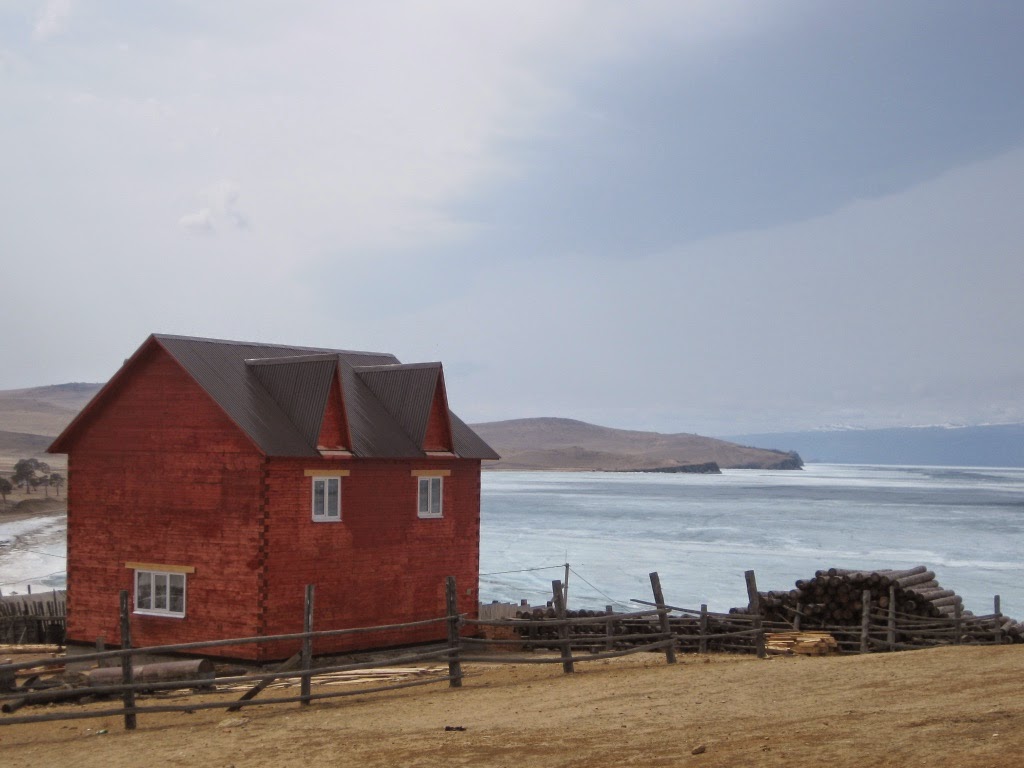
After spending no more than a couple nights each in Ekaterinburg, Novosibirsk, Krasnoyarsk, and Irkutsk, I made a longer stop at Lake Baikal. For the last five nights, I’ve been staying at a guesthouse on an island in the deepest lake in the world. Until recently, Olkhon wasn’t much of a travel destination. But with the recent arrival of electricity to the island, it’s become a bit more tourist friendly. Give it another decade, and I wouldn’t be surprised if there’s a paved road or two here.

Olkhon Island in Lake Baikal

My 6-hour journey to the island started with a marshrutka ride from Irkutsk. The 14-passenger van was devoid of foreigners, though there was a dog along for the trip. We crossed through barren steppes where the only signs of civilization were the occasional settlements of dilapidated wooden houses, but nothing that would even qualify as a small village. Much of the ride was along bumpy dirt roads—our vehicle’s suspension system left much to be desired, and the ride was about as smooth as if I had opted to make the journey on horseback. In the winter, you can drive across the frozen lake to reach the island, but now the ice is already half-melted. Therefore, we took an air-cushion hovercraft that can travel across both ice and water.

The hovercraft arriving at the island

In the off-season, there’s not much to do on the island. It’s too warm for snow sports, but far too cold (and icy) for swimming. Instead, I’ve spent the last five days exploring the island and meeting other guests. I spent a day hiking through the forest with a woman from South Korea who is riding the Trans-Siberian with her parents, a day walking to the second largest village on the island (population: 200) with a thrice-divorced and mostly insane Russian man who shares the same name as my novel’s hero, and I was adopted by an Argentine family for a few days. Three days of speaking entirely in Spanish did nothing for my Russian, but I’ve now got an invitation to visit them in Santa Rosa de La Pampa that I’m going to have to capitalize on—Argentina isn’t so far from Texas, right?

Siberian spring

As expected, the Siberian wilderness is an entirely different world than the Russian capital. Life moves at a different pace and lacks the conveniences of Moscow. The grocery stores have very little selection (you can’t even find bread), and since you can only buy gas on the mainland, most of the roads are deserted. On the other hand, the residents of Olkhon get to enjoy natural beauty unlike anything you would see in Moscow. There are playgrounds perched on cliffs overlooking the icy surface of Lake Baikal and cow-yak hybrids wandering untethered through a former gulag. While everyone tells me Olkhon is far more interesting in the summer, I loved the abandoned calm of early spring.


Today I return to the mainland, then I’m catching an overnight train to Ulan Ude. Only 73 hours and 22 minutes of train rides left!